Tuesday, November 11, 2008
an amateur economist could summarizeand simplify the Chinese economy as 39-37-37: anastonishingly large 39% of the GDP is capital spending,37% is internal consumption, and an amount equal to37% of GDP is exported. (These numbers do not sum to100 as we are not using exports net of imports becausewe are concerned with the vulnerability of total exportsto a weak global economy.) The U.S., in comparison, is19-70-13, disturbingly on the other side of normal; 70%consumption compared with 57% in both Germany andJapan, for example, and nearly twice that in China. China’smix is of course an utterly unprecedented one, and comeswith great advantages in booming times. Now, however,we might ask: how do you stimulate the building of a newsteel mill when rows of mills are sitting empty? How doyou increase exports into a global economy that is not justslowing, but is unexpectedly very weak? And are theygood enough at stimulating local consumption to have animpact on such a small percentage of GDP in the face ofa negative wealth effect from declining stock and housingprices in their local market?Simple old “Econ 101” thinking would suggest that theircapital goods sector will have a bigger drop than the restof the economy, and that export growth rates might slowfrom very large to even nil or worse


govt here must focus on local consumption to compensate for decline in exports and foreign capital investment in next 2 years. unfortunately, private consumption is only 40+% of GDP and government consumption only 12+% of GDP, so will need large stimulus to compensate for major potential declines in other areas that government cannot do much about.
I learnt hard way about Buffet. Exactly 1 year ago, he exited PetroChina after gaining something like 700% in a few years.PetroChina continued to climb, and buffet said perhaps he sold too early. So I went in thinking I could be smarter than him....PetroChina has since dropped 80% fm peak. He managed to make people like me think he was wrong by exiting too early while smiling all the way to the bank. Hence, ignore his actions at your peril !!!
Talking about knowledge, the last 10 years the number of polytechnics and university graduates had been mass produced like commodities..... 20-30years ago, entry into university are only top brilliant, now is like everywhere.....nowadays even university need to have fancy advertisements to compete against each others...too many vacancies........last time, when A level results out, there is only a small standard notice on the newspaper that university is open to application....what a huge difference
Singapore this month cut its economic growth forecast for 2008 to 3.0 percent from between 4.0 and 5.0 percent after the economy slipped into a technical recession, described as two consecutive quarters of negative growth.Real gross domestic product (GDP) declined by 6.3 percent in the third quarter after contracting 5.7 percent in the previous quarter, according to preliminary government data.The MAS said Singapore's financial sector will suffer from a direct impact, while weakening consumer sentiment will affect retail trade and the property market.Other segments of the econonomy like manufacturing and tourism will suffer from falling external demand, it said
Sunday, November 9, 2008
It's better to miss out no than regret later
By R S
SINGAPORE - Fear manifests itself in the stock market in two and only two ways. First is fear of losing money, which emerges when prices are plummeting and all mayhem is breaking loose, as was the case for most of last month. This stage is characterised by plenty of hand-wringing as investors agonise over whether to sell, or cut losses, or pay up their margin calls or, in the case of die-hard believers, to try and ride out the plunges and hope that one day they'll be in the black again.
Second is fear of losing the chance to make money, which occurs when a sudden rebound occurs and the majority are caught unprepared. The hand-wringing is then complemented by kicking oneself - sometimes with both feet - for not having had the courage to have bought earlier.
Since the Straits Times Index has now bounced almost 20 per cent from its intraday low of 1,500 a couple of weeks ago, there must be plenty of self-inflicted kicking going on, which together with equal doses of hand-wringing, is followed by the inevitable, gnawing question: should I take the plunge or risk being left out?
The mistake investors make when fear of losing out takes hold is to rely on most recent memory, say the 2-3 weeks just passed, and extrapolate this to the next most immediate period. It doesn't work that way at all - in this environment, patience is a virtue because it's much wiser to miss out on the best if it helps you avoid the worst.
First, volatility is still way too high, with 5-10 per cent intraday swings now commonplace. This is one legacy of the Greenspan/Bernanke/Bush administration, which failed to detect the widening fissures in the US property and banking markets and kept marvelling at just how strong its economy and banking system were even when the cracks appeared.
Second is that the worst of the economic crunch has yet to be seen. US unemployment can rise as high as 8 per cent - unheard of in the modern era - and nobody knows with even the slightest clarity when things will improve.
As research outfit Ideaglobal said over the weeked when asking whether it's time to call a recession: 'old wisdom has it that if it looks like a duck and quacks like a duck, chances are it's a duck'.
Third is the problem of how to shake off the present recession and inevitable depression to follow. There is no guarantee that the standard policy responses of cutting interest rates to zero to try and engineer positive inflation and generous tax cuts to stoke consumer spending and demand will work - Japan has tried everything but has been in mired in a deflatioanry environment for almost 20 years with nothing seeming to work.
Interestingly, Federal Reserve chairman Ben Bernanke six years ago delivered a speech that dealt with deflation, in which he said prevention is better than cure because of the difficulties associated with the cure. It's also worth noting that he said there was no imminent threat of deflation at the time because the US economy was so strong and the banking system was so robust and well-regulated. It'll certainly be interesting to see if he lives up to his preferred prescription at that time of resorting to the printing press and flooding the market with US dollars to combat deflation. In the worst-case scenario, all he may be doing is following in the footsteps of his predecessor Alan Greenspan - as one commentator noted about the hoped-for bailouts: 'let's start another cycle of easy credit, leading to leverage, no regulation, opaque self-serving instruments of mass financial destruction, leading to another bubble, leads fat cats to whine, brings a federal bailout and lets the cycle repeat itself'.
As for the local market, its fortunes will continue to be dictated by expectations of how Wall Street might perform later each day - Friday's bounce in the Straits Times Index despite a huge US loss on Thursday confirms that programme trades buy stocks here first before the US.
However Wall Street's rise on Friday was most likely due to short-covering after a 10 per cent collapse on Wednesday and Thursday and is very likely to fizzle out soon.
The upshot of all this is that patience is a virtue and that it's better to miss out now than regret being hasty later.
By R S
SINGAPORE - Fear manifests itself in the stock market in two and only two ways. First is fear of losing money, which emerges when prices are plummeting and all mayhem is breaking loose, as was the case for most of last month. This stage is characterised by plenty of hand-wringing as investors agonise over whether to sell, or cut losses, or pay up their margin calls or, in the case of die-hard believers, to try and ride out the plunges and hope that one day they'll be in the black again.
Second is fear of losing the chance to make money, which occurs when a sudden rebound occurs and the majority are caught unprepared. The hand-wringing is then complemented by kicking oneself - sometimes with both feet - for not having had the courage to have bought earlier.
Since the Straits Times Index has now bounced almost 20 per cent from its intraday low of 1,500 a couple of weeks ago, there must be plenty of self-inflicted kicking going on, which together with equal doses of hand-wringing, is followed by the inevitable, gnawing question: should I take the plunge or risk being left out?
The mistake investors make when fear of losing out takes hold is to rely on most recent memory, say the 2-3 weeks just passed, and extrapolate this to the next most immediate period. It doesn't work that way at all - in this environment, patience is a virtue because it's much wiser to miss out on the best if it helps you avoid the worst.
First, volatility is still way too high, with 5-10 per cent intraday swings now commonplace. This is one legacy of the Greenspan/Bernanke/Bush administration, which failed to detect the widening fissures in the US property and banking markets and kept marvelling at just how strong its economy and banking system were even when the cracks appeared.
Second is that the worst of the economic crunch has yet to be seen. US unemployment can rise as high as 8 per cent - unheard of in the modern era - and nobody knows with even the slightest clarity when things will improve.
As research outfit Ideaglobal said over the weeked when asking whether it's time to call a recession: 'old wisdom has it that if it looks like a duck and quacks like a duck, chances are it's a duck'.
Third is the problem of how to shake off the present recession and inevitable depression to follow. There is no guarantee that the standard policy responses of cutting interest rates to zero to try and engineer positive inflation and generous tax cuts to stoke consumer spending and demand will work - Japan has tried everything but has been in mired in a deflatioanry environment for almost 20 years with nothing seeming to work.
Interestingly, Federal Reserve chairman Ben Bernanke six years ago delivered a speech that dealt with deflation, in which he said prevention is better than cure because of the difficulties associated with the cure. It's also worth noting that he said there was no imminent threat of deflation at the time because the US economy was so strong and the banking system was so robust and well-regulated. It'll certainly be interesting to see if he lives up to his preferred prescription at that time of resorting to the printing press and flooding the market with US dollars to combat deflation. In the worst-case scenario, all he may be doing is following in the footsteps of his predecessor Alan Greenspan - as one commentator noted about the hoped-for bailouts: 'let's start another cycle of easy credit, leading to leverage, no regulation, opaque self-serving instruments of mass financial destruction, leading to another bubble, leads fat cats to whine, brings a federal bailout and lets the cycle repeat itself'.
As for the local market, its fortunes will continue to be dictated by expectations of how Wall Street might perform later each day - Friday's bounce in the Straits Times Index despite a huge US loss on Thursday confirms that programme trades buy stocks here first before the US.
However Wall Street's rise on Friday was most likely due to short-covering after a 10 per cent collapse on Wednesday and Thursday and is very likely to fizzle out soon.
The upshot of all this is that patience is a virtue and that it's better to miss out now than regret being hasty later.
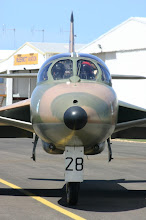
Hawker Hunter
The Hawker Hunter weighs 10,000kg , has a length of 14m and a width of 10.35 m. It has a maximum speed of 1300km/hr and is supersonic in a shallow dive.
From 'Those that Dared'
Hello Dave and team, Just a quick note to say how exhilarating it was to take my first 'Hunter Flight'. Nothing can prepare you for the feeling of the G forces building and the sheer thrill of speeding over the water and beach-scape while flying at low-level. Dave made the whole process feel completely safe due to his vast experience and obvious flying skills. It was also marvelous to spend a few hours with a group of people who have such a passion for what they do and the professional way they imparted something of the history of the Hunter. That helped to make the whole experience a totally enjoyable one. I will be highly recommending the flight to anyone who is interested in doing something special for once in their lives. Many thanks to all involved. Best Regards, Garry Wilbraham.
Garry - May 30th 2006
Know and use all the capabilities in your airplane. If you don't, sooner or later, some guy who does use them all will kick your ass.
Lieutenant Dave 'Preacher'Pace, USN - Nov 12th 2005
The important thing in aeroplanes is that they shall be speedy.
Baron Manfred von Richthofen - Nov 12th 2005
Beware the lessons of a fighter pilot who would rather fly a slide rule than kick your ass!
Commander Ron 'Mugs'McKeown, USN - Nov 12th 2005
He who gets excited in fighting is sure to make mistakes.
Baron manfred von Richthofen - Nov 12th 2005
Speed is life.
Israeli Tactics Manual - Nov 12th 2005
I never went into the air thinking I would lose.
Commander Randy 'Duke'Cunningham, USN - Nov 12th 2005
You fight like you train.
Motto TOPGUN - Nov 12th 2005
An excellent weapon and luck had been on my side. To be successful the best fighter pilot needs both.
Lt. General Adolph Galland - Nov 12th 2005
It was qviet, very fast, not noisy or cold in the cockpit with an astounding rate of climb...very un-gentlemanly, should be banned
Baron Von Richtofen - Aug 24th 2005
Hello Dave and team, Just a quick note to say how exhilarating it was to take my first 'Hunter Flight'. Nothing can prepare you for the feeling of the G forces building and the sheer thrill of speeding over the water and beach-scape while flying at low-level. Dave made the whole process feel completely safe due to his vast experience and obvious flying skills. It was also marvelous to spend a few hours with a group of people who have such a passion for what they do and the professional way they imparted something of the history of the Hunter. That helped to make the whole experience a totally enjoyable one. I will be highly recommending the flight to anyone who is interested in doing something special for once in their lives. Many thanks to all involved. Best Regards, Garry Wilbraham.
Garry - May 30th 2006
Know and use all the capabilities in your airplane. If you don't, sooner or later, some guy who does use them all will kick your ass.
Lieutenant Dave 'Preacher'Pace, USN - Nov 12th 2005
The important thing in aeroplanes is that they shall be speedy.
Baron Manfred von Richthofen - Nov 12th 2005
Beware the lessons of a fighter pilot who would rather fly a slide rule than kick your ass!
Commander Ron 'Mugs'McKeown, USN - Nov 12th 2005
He who gets excited in fighting is sure to make mistakes.
Baron manfred von Richthofen - Nov 12th 2005
Speed is life.
Israeli Tactics Manual - Nov 12th 2005
I never went into the air thinking I would lose.
Commander Randy 'Duke'Cunningham, USN - Nov 12th 2005
You fight like you train.
Motto TOPGUN - Nov 12th 2005
An excellent weapon and luck had been on my side. To be successful the best fighter pilot needs both.
Lt. General Adolph Galland - Nov 12th 2005
It was qviet, very fast, not noisy or cold in the cockpit with an astounding rate of climb...very un-gentlemanly, should be banned
Baron Von Richtofen - Aug 24th 2005
My endorsement on this exciting aircraft was completed on this 40 minute flight.
A wonderful flight of 40 minutes was completed on February 7th.
The weather at last was superb and we completed my endorsement training practicing general handling, some aerobatics and forced landing and approaches on a long beach north of Noosa.
It was all fantastic, and I really enjoy flying this superb aircraft. The flight was completed with one approach and landing back at Sunshine Coast Airport.
With the endorsement training now completed, we are presently doing some work on the fuel indication system and if all goes to plan we hope to fly again on Friday 19th March.
A wonderful flight of 40 minutes was completed on February 7th.
The weather at last was superb and we completed my endorsement training practicing general handling, some aerobatics and forced landing and approaches on a long beach north of Noosa.
It was all fantastic, and I really enjoy flying this superb aircraft. The flight was completed with one approach and landing back at Sunshine Coast Airport.
With the endorsement training now completed, we are presently doing some work on the fuel indication system and if all goes to plan we hope to fly again on Friday 19th March.
"OK - my first chance to let the F-22 loose on takeoff. I was the last IOT&E ( I think this means Initial Operational Test and Eval) pilot at Edwards and it was only a few months before I was to move to Langley. The test folks were nice enough to still let me fly there occasionally, and they had a perfect mission for me. It was a single ship, no test support (control room) required, and I had my own tanker. All I had to do was takeoff and fly around for 2 hours collecting data from the MLD's (missile launch detectors). In other words it was a free sortie with a lot of gas available and I had the airspace to myself since it didn't matter what I did during the sortie, in fact more maneuvering was better to get data. Having never had a chance to really see what the jet would be like on takeoff, and since I had a tanker to keep me full of gas, I decided to do a max performance takeoff and let it go straight up to see what it would do. Edwards has that 15,000 foot runway, and an unlimited ceiling since it sits in a restricted airspace. So on taxi I asked for a max climb out to 25,000 feet, the controller said, 29,000? I said, sure that'll work. I really had no idea what I'd end up with and with my Eagle time I figured I'd be lucky to get to 29,000. So I let it go to about 570 or so which was prior to the end of the runway and started a pull, not too much g, maybe 4 or 5, and went to 90 degrees nose high. I wasn't really paying attention to the airspeed or altitude because I was really enjoying the view and the ride, it was amazing. I started to feel a little buffet and looked inside to see what the deal was, expecting that I was starting to slow down to the point where I was getting the same kind of buffet you feel as the jet slows down and a little alpha starts to build on the wings, that's how it goes in a Eagle too. Well, there's also a little buffet in the Raptor when you're about to go supersonic, and to my surprise, and I started laughing, the jet was at .99 mach and trying its best to punch through to supersonic flight, straight up, passing about 18 or 19 thousand feet or so, it began a slow deceleration as I stared in awe at the HUD mach indication and at .94 mach I realized I was at 25,000 and was going to blast way through my altitude, so I rolled and started a 4 to 5 g pull to level out, which of course didn't work and I leveled at about 31,500 feet at about 330knots (don't know why those numbers stick in my head but they do). Now for you pilots out there, you know when you pull g, especially at higher altitudes and heavy weight, it's a fairly energy depleting event. So go figure, I'm FULLY loaded with fuel at takeoff, ALL of the weapons bays were loaded, so I am in my combat configuration, in a regular line jet, no tweaks, no special modifications, no weight taken out (as in the Streak Eagle or Mig 25 flights, etc.), nothing, just a line jet any old pilot could step to and fly. So I talked to the engineers and with some quick math they guessed I could have topped out in the low 60 thousand numbers. That wasn't flying a special profile like other jets have either (Rutowski profile - misspelled?), it was just a pull to the nose straight up. This...jet...is...a...monster!!" -Marc
Subscribe to:
Posts (Atom)